Quando Jesus Cristo apareceu ressuscitado na casa onde os discípulos estavam reunidos, Tomé era o único deles que estava ausente. É graças à sua dúvida que surgiu a expressão popular: “Sou que nem São Tomé: preciso ver para crer”, pois o santo não acreditou na aparição do Senhor. Quando ele vê Cristo em seu corpo glorioso e chagado, é convidado a tocar em suas feridas para ter certeza do que via. Também é a partir dele a jaculatória que surgiu: “Meu Senhor e Meu Deus, eu creio, mas aumentai a minha fé”.
Você já se questionou sobre o que realmente crê? O quão autêntica e verdadeira é a sua fé? Enfim: as coisas que você crê são realmente as devidas ou as indevidas (como superstições e mandingas populares que ainda possa acreditar)?
Reflita: falta-lhe a fé madura?
Se sim, usemos São Tomé como exemplo de conversão verdadeira para não termos dúvida do que cremos, lutamos e esperamos.
Abaixo, extraído de “Santo do Dia” da o site Canção Nova.
SÃO TOMÉ
São Tomé nunca teve medo de expor a realidade de sua fé e de sua razão
Pertenceu ao grupo dos doze apóstolos. O Senhor o chamou dentro de sua realidade, com suas fraquezas e até com suas crises de fé.
Nosso Senhor Jesus revelou a nós coisas maravilhosas através de São Tomé:
“Tomé lhe disse: ‘Senhor, nós nem sabemos para onde vais, como poderíamos saber o caminho?’ Jesus lhe disse: Eu sou o caminho, a verdade e a vida. Ninguém vai ao Pai a não ser por mim” (Jo 14,6).
Tomé nunca teve medo de expor a realidade de sua fé e de sua razão, que queria saber cada vez mais e melhor. Quando Jesus apareceu aos apóstolos ao ressuscitar, Tomé não estava ali, e aí encontramos seu testemunho: “Oito dias depois, os discípulos encontravam-se reunidos na casa, e Tomé estava com eles. Estando as portas fechadas, Jesus entrou, pôs-se no meio deles e disse: “A paz esteja convosco”. Depois disse a Tomé: “Põe o teu dedo aqui e olha as minhas mãos. Estende a tua mão e coloca-a no meu lado e não sejas incrédulo, mas crê!” Tomé respondeu: “Meu Senhor e meu Deus!” (Jo 20,26-28).
O Papa São Gregório Magno meditando essa realidade de São Tomé diz: “A incredulidade de Tomé não foi um acaso, mas prevista nos planos de Deus. O discípulo, que, duvidando da Ressurreição do Mestre, pôs as mãos nas chagas do mesmo, curou com isso a ferida da nossa incredulidade”.
Segundo a Tradição, Tomé teria ido, depois de Pentecostes, evangelizar pelo Oriente e Índia onde morreu martirizado, ou seja, morreu por amor, testemunhando a sua fé.
São Tomé, rogai por nós !
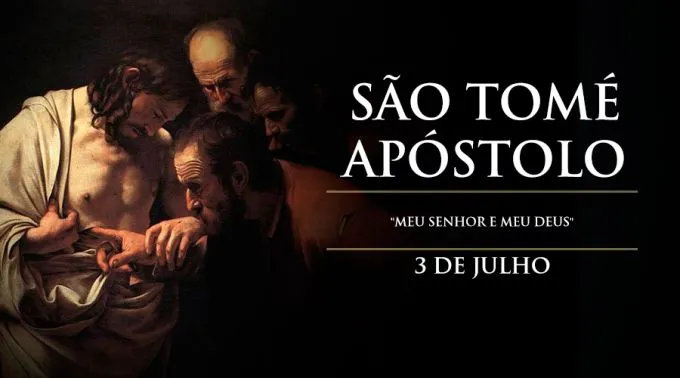
Imagem extraída de ACI Digital.
IN ENGLISH – When Jesus Christ appeared resurrected in the house where the disciples were gathered, Thomas was the only one of them who was absent. It was because of his doubt that the popular expression arose: “I’m like Saint Thomas: I need to see to believe”, because the saint did not believe in the Lord’s appearance. When he sees Christ in his glorious and wounded body, he is invited to touch his wounds to be sure of what he saw. It is also from him that the aspiration arose: “My Lord and my God, I believe, but increase my faith”.
Have you ever questioned what you really believe? How authentic and true is your faith? Finally: are the things you believe really the right ones or the wrong ones (such as superstitions and popular witchcraft that you may still believe)?
Reflect: do you lack mature faith?
If so, let us use Saint Thomas as an example of true conversion so that we have no doubt about what we believe, fight for and hope for.
Below, excerpt from “Saint of the Day” from the Canção Nova website.
SAINT THOMAS
Saint Thomas was never afraid to expose the reality of his faith and reason.
He belonged to the group of the twelve apostles. The Lord called him within his reality, with his weaknesses and even with his crises of faith.
Our Lord Jesus revealed wonderful things to us through Saint Thomas:
“Thomas said to him, ‘Lord, we do not know where you are going, so how can we know the way?’ Jesus said to him, ‘I am the way, the truth, and the life. No one comes to the Father except through me’” (Jn 14:6).
Thomas was never afraid to expose the reality of his faith and reason, which he wanted to know more and better. When Jesus appeared to the apostles after his resurrection, Thomas was not there, and here we find his testimony: “Eight days later, the disciples were in the house, and Thomas was with them. Although the doors were locked, Jesus came and stood among them and said, “Peace be with you.” Then he said to Thomas, “Put your finger here and see my hands. Stretch out your hand and put it into my side, and do not be unbelieving, but believe.” Thomas answered, “My Lord and my God!” (Jn 20:26-28).
Pope Saint Gregory the Great, reflecting on this reality of Saint Thomas, says: “Thomas’ unbelief was not a coincidence, but foreseen in God’s plans. The disciple, who, doubting the Master’s Resurrection, placed his hands on His wounds, thereby healed the wound of our unbelief.”
According to Tradition, Thomas went, after Pentecost, to evangelize in the East and India, where he died a martyr, that is, he died for love, bearing witness to his faith.
Saint Thomas, pray for us!

 DISCUTINDO CONTEMPORANEIDADES