– O iraniano e o americano no palco do futebol:

Futebol e política se misturam?

Em meio às tensões Irã – Israel / EUA, a Copa do Mundo de Clubes viu o iraniano Alireza Faghani apitando a final (contrariando a expectativa de Ramon Abatti Abel estar no jogo, pois foi muito bem no torneio, além dos elogoios da própria Comissão de Arbitragem).

Na foto, abaixo, o presidente americano Donald Trump ao lado do árbitro iraniano. Fiquei pensando: existiu alguma influência política na escolha do juizão, para um eventual momento como esse, ou não?

Sinceramente, quero crer na meritocracia.

IN ENGLISH – Do football and politics mix? Amidst the Iran-Israel/US tensions, the Club World Cup saw Iranian Alireza Faghani refereeing the final (contrary to expectations that Ramon Abatti Abel would officiate, as he performed very well in the tournament and received praise from the Refereeing Committee itself). In the photo below, American President Donald Trump is alongside the Iranian referee. It made me wonder: was there any political influence in the choice of the referee, for a moment like this, or not? Honestly, I want to believe in meritocracy.

– O iraniano e o americano no palco do futebol:

Futebol e política se misturam?

Em meio às tensões Irã – Israel / EUA, a Copa do Mundo de Clubes viu o iraniano Alireza Faghani apitando a final (contrariando a expectativa de Ramon Abatti Abel estar no jogo, pois foi muito bem no torneio, além dos elogoios da própria Comissão de Arbitragem).

Na foto, abaixo, o presidente americano Donald Trump ao lado do árbitro iraniano. Fiquei pensando: existiu alguma influência política na escolha do juizão, para um eventual momento como esse, ou não?

Sinceramente, quero crer na meritocracia.

– Por que Textor demitiu Renato Paiva? Ele mesmo responde:

Para a TV da Inglaterra, John Textor, dono do Botafogo SAF, justificou a demissão de Renato Paiva. Abaixo, toda a explicação, mas, resumidamente, foi: não jogou no estilo “Botafogo Way”! E lembrou: não gosta de demitir treinador.

Extraído do GE:

Por que demiti Renato Paiva depois de ele vencer o PSG? Ele quebrou seus próprios princípios, não seguiu o plano. Ele é um treinador posicional, muito bom em educar os jogadores, e os torcedores ficaram irritados com a forma como jogamos. Deveríamos ter vencido Atlético de Madrid e Palmeiras, somos melhores do que o Palmeiras. Ele quebrou os princípios dele – afirmou Textor, em participação no programa da “TalkSport”, na Inglaterra.

Textor ficou irritado com a postura do time contra o Palmeiras, como o ge revelou em matéria de bastidores. O americano fez um discurso sobre oBotafogo Way, um estilo de jogo ofensivo e propositivo, para os jogadores no almoço após a derrota e demitiu o português no dia seguinte.

Perguntei a ele qual foi o melhor jogo da sua carreira e ele respondeu PSG. Depois, perguntei qual foi o melhor jogo da minha carreira, e eu disse PSG. Eu disse que aqui (dia do jogo) não era o PSG, era o Palmeiras. Palmeiras não é o PSG. “É hora de jogar futebol, vão lá e acabe com eles”. O que aconteceu? Ficamos recuados e vimos o adversário avançar. Em 10 jogos, ele estava ficando cada vez mais defensivo e, quando você quebra os seus princípios, você tem que sair – completou.

— Nós ganhamos títulos, não é? Não tomo as decisões sozinho. Se todo o departamento de futebol vem até mim e fala que precisamos fazer algo sobre o treinador, eu me mexo. Eu não gosto de demitir pessoas. Você viu que o estilo de jogo do time mudou durante 10 jogos. Paiva é um grande treinador, mas ele tem manter seu estilo de jogo no próximo trabalho. Ele não pode deixar os torcedores reclamando no Brasil (influenciarem), eles são brutais – analisou.

Obviamente, muitos palmeirenses questionarão a citação do CEO do Botafogo… Mas, cá entre nós: o Fogão realmente abdicou de jogar contra o Palmeiras. “Dava jogo” sim.

In English – Speaking to English TV, John Textor, owner of Botafogo SAF, justified the dismissal of Renato Paiva. Below is the full explanation, but, in summary, it was: he didn’t play in the “Botafogo Way” style! And he reiterated: he doesn’t like firing coaches.

Excerpted from GE:

“Why did I fire Renato Paiva after he beat PSG? He broke his own principles; he didn’t follow the plan. He’s a positional coach, very good at educating players, and the fans were irritated with the way we played. We should have beaten Atlético de Madrid and Palmeiras; we are better than Palmeiras. He broke his principles,” Textor stated, participating in the “TalkSport” program in England.

Textor was irritated with the team’s stance against Palmeiras, as GE revealed in a behind-the-scenes report. The American gave a speech about the “Botafogo Way,” an offensive and proactive playing style, to the players at lunch after the defeat and fired the Portuguese coach the next day.

“I asked him what the best game of his career was, and he said PSG. Then I asked what the best game of my career was, and I said PSG. I said that here (on game day) it wasn’t PSG; it was Palmeiras. Palmeiras is not PSG. ‘It’s time to play football, go out there and finish them.’ What happened? We sat back and watched the opponent advance. In 10 games, he was becoming more and more defensive, and when you break your principles, you have to leave,” he added.

“We win titles, don’t we? I don’t make decisions alone. If the entire football department comes to me and says we need to do something about the coach, I make a move. I don’t like firing people. You saw that the team’s playing style changed over 10 games. Paiva is a great coach, but he has to maintain his playing style in his next job. He can’t let the complaining fans in Brazil (influence him); they are brutal,” he analyzed.

Obviously, many Palmeiras fans will question the Botafogo CEO’s statement… But, between us: Botafogo really gave up playing against Palmeiras. It “was a playable game,” yes.

– Quanto está ganhando cada árbitro no Mundial de Clubes?

Sabemos que a premiação da Copa do Mundo de Clubes é maior do que a Copa do Mundo de Seleções. O motivo é: o patrocínio “turbinado” do PIF, o Fundo da Arábia Saudita para eventos esportivos que viabilizou a competição (e que comprou parte da DAZN, detentora dos direitos de transmissão, além de ser o órgão que supostamente “injetou dinheiro” para a Copa de 2034 ser no Oriente Médio – acusado por praticar Sportwashing).

As taxas de arbitragem, consequentemente, também se valorizaram. Vide:

Na Copa do Mundo de Seleções Catar 2022, todos os árbitros receberam um valor fixo de € 20,000.00, além de adicionais por partida apitada (€ 5 mil na fase de grupos e € 10 mil nos mata-matas).

Já para a Copa do Mundo de Clubes USA 2025, com essa majoração de valores, segundo o Portal Lance! na coluna Biz, reproduzindo agências internacionais, todos os árbitros receberão um valor fixo de US$ 70,000.00, além de adicionais por partida apitada (US$ 3 mil na fase de grupos e US$ 10 mil nos mata-matas).

Tá bom, ou não?

Quem está no Mundial, está ganhando dinheiro, sem dúvida.

IN ENGLISH – We know that the prize money for the Club World Cup is greater than that of the National Team World Cup. The reason for this is the “boosted” sponsorship from PIF, the Saudi Arabian Public Investment Fund for sporting events, which made the competition possible. (PIF also bought a stake in DAZN, which holds broadcasting rights, and is the entity that allegedly “injected money” to ensure the 2034 World Cup would be in the Middle East—accused of sportswashing).

Consequently, referee fees have also increased. Consider this:

At the Qatar 2022 National Team World Cup, all referees received a fixed fee of €20,000.00, plus additional amounts per match officiated (€5,000 in the group stage and €10,000 in the knockout rounds).

However, for the USA 2025 Club World Cup, with these increased values, according to Portal Lance!’s Biz column, citing international agencies, all referees will receive a fixed fee of US$70,000.00, plus additional amounts per match officiated (US10,000 in the knockout rounds).

Is that good, or not?

Anyone involved in the Club World Cup is undoubtedly making money

– Abatti Abel apitará a final do Mundial?

Já sabemos que o árbitro Wilton Sampaio NÃO estará na final do Mundial de Clubes, pois está escalado para Flamengo x São Paulo no sábado.

Todos os demais FIFAs e aspirantes na escala, exceto Ramon Abatti Abel.

Estou apostando nele como árbitro de Chelsea x PSG.

– Por que Textor demitiu Renato Paiva? Ele mesmo responde:

Para a TV da Inglaterra, John Textor, dono do Botafogo SAF, justificou a demissão de Renato Paiva. Abaixo, toda a explicação, mas, resumidamente, foi: não jogou no estilo “Botafogo Way”! E lembrou: não gosta de demitir treinador.

Extraído do GE:

Por que demiti Renato Paiva depois de ele vencer o PSG? Ele quebrou seus próprios princípios, não seguiu o plano. Ele é um treinador posicional, muito bom em educar os jogadores, e os torcedores ficaram irritados com a forma como jogamos. Deveríamos ter vencido Atlético de Madrid e Palmeiras, somos melhores do que o Palmeiras. Ele quebrou os princípios dele – afirmou Textor, em participação no programa da “TalkSport”, na Inglaterra.

Textor ficou irritado com a postura do time contra o Palmeiras, como o ge revelou em matéria de bastidores. O americano fez um discurso sobre oBotafogo Way, um estilo de jogo ofensivo e propositivo, para os jogadores no almoço após a derrota e demitiu o português no dia seguinte.

Perguntei a ele qual foi o melhor jogo da sua carreira e ele respondeu PSG. Depois, perguntei qual foi o melhor jogo da minha carreira, e eu disse PSG. Eu disse que aqui (dia do jogo) não era o PSG, era o Palmeiras. Palmeiras não é o PSG. “É hora de jogar futebol, vão lá e acabe com eles”. O que aconteceu? Ficamos recuados e vimos o adversário avançar. Em 10 jogos, ele estava ficando cada vez mais defensivo e, quando você quebra os seus princípios, você tem que sair – completou.

— Nós ganhamos títulos, não é? Não tomo as decisões sozinho. Se todo o departamento de futebol vem até mim e fala que precisamos fazer algo sobre o treinador, eu me mexo. Eu não gosto de demitir pessoas. Você viu que o estilo de jogo do time mudou durante 10 jogos. Paiva é um grande treinador, mas ele tem manter seu estilo de jogo no próximo trabalho. Ele não pode deixar os torcedores reclamando no Brasil (influenciarem), eles são brutais – analisou.

Obviamente, muitos palmeirenses questionarão a citação do CEO do Botafogo… Mas, cá entre nós: o Fogão realmente abdicou de jogar contra o Palmeiras. “Dava jogo” sim.

In English – Speaking to English TV, John Textor, owner of Botafogo SAF, justified the dismissal of Renato Paiva. Below is the full explanation, but, in summary, it was: he didn’t play in the “Botafogo Way” style! And he reiterated: he doesn’t like firing coaches.

Excerpted from GE:

“Why did I fire Renato Paiva after he beat PSG? He broke his own principles; he didn’t follow the plan. He’s a positional coach, very good at educating players, and the fans were irritated with the way we played. We should have beaten Atlético de Madrid and Palmeiras; we are better than Palmeiras. He broke his principles,” Textor stated, participating in the “TalkSport” program in England.

Textor was irritated with the team’s stance against Palmeiras, as GE revealed in a behind-the-scenes report. The American gave a speech about the “Botafogo Way,” an offensive and proactive playing style, to the players at lunch after the defeat and fired the Portuguese coach the next day.

“I asked him what the best game of his career was, and he said PSG. Then I asked what the best game of my career was, and I said PSG. I said that here (on game day) it wasn’t PSG; it was Palmeiras. Palmeiras is not PSG. ‘It’s time to play football, go out there and finish them.’ What happened? We sat back and watched the opponent advance. In 10 games, he was becoming more and more defensive, and when you break your principles, you have to leave,” he added.

“We win titles, don’t we? I don’t make decisions alone. If the entire football department comes to me and says we need to do something about the coach, I make a move. I don’t like firing people. You saw that the team’s playing style changed over 10 games. Paiva is a great coach, but he has to maintain his playing style in his next job. He can’t let the complaining fans in Brazil (influence him); they are brutal,” he analyzed.

Obviously, many Palmeiras fans will question the Botafogo CEO’s statement… But, between us: Botafogo really gave up playing against Palmeiras. It “was a playable game,” yes.

– Futebol ilógico…

Uma lógica bem ilógica do futebol…

Que esporte sensacional: o possível campeão do mundo só perdeu para o Botafogo. Olhe aí:

– E deu o esperado no Mundial de Clubes.

Jogou-se tanto na Copa do Mundo de Clubes, e… deu a lógica: uma final europeia vem por aí!

Teremos Real Madrid ou PSG contra Chelsea (eu achei que seria o Manchester City.)

Nada de novo no futebol. Meu palpite: espanhóis ou franceses levarão o caneco.

IN ENGLISH – There was so much play at the Club World Cup, and… logic prevailed: a European final is coming!

We’ll have Real Madrid or PSG against Chelsea (I thought it would be Manchester City.)

Nothing new in football.

My guess: the Spanish or French will take home the trophy.

– Quanto está ganhando cada árbitro no Mundial de Clubes?

Sabemos que a premiação da Copa do Mundo de Clubes é maior do que a Copa do Mundo de Seleções. O motivo é: o patrocínio “turbinado” do PIF, o Fundo da Arábia Saudita para eventos esportivos que viabilizou a competição (e que comprou parte da DAZN, detentora dos direitos de transmissão, além de ser o órgão que supostamente “injetou dinheiro” para a Copa de 2034 ser no Oriente Médio – acusado por praticar Sportwashing).

As taxas de arbitragem, consequentemente, também se valorizaram. Vide:

Na Copa do Mundo de Seleções Catar 2022, todos os árbitros receberam um valor fixo de € 20,000.00, além de adicionais por partida apitada (€ 5 mil na fase de grupos e € 10 mil nos mata-matas).

Já para a Copa do Mundo de Clubes USA 2025, com essa majoração de valores, segundo o Portal Lance! na coluna Biz, reproduzindo agências internacionais, todos os árbitros receberão um valor fixo de US$ 70,000.00, além de adicionais por partida apitada (US$ 3 mil na fase de grupos e US$ 10 mil nos mata-matas).

Tá bom, ou não?

Quem está no Mundial, está ganhando dinheiro, sem dúvida.

IN ENGLISH – We know that the prize money for the Club World Cup is greater than that of the National Team World Cup. The reason for this is the “boosted” sponsorship from PIF, the Saudi Arabian Public Investment Fund for sporting events, which made the competition possible. (PIF also bought a stake in DAZN, which holds broadcasting rights, and is the entity that allegedly “injected money” to ensure the 2034 World Cup would be in the Middle East—accused of sportswashing).

Consequently, referee fees have also increased. Consider this:

At the Qatar 2022 National Team World Cup, all referees received a fixed fee of €20,000.00, plus additional amounts per match officiated (€5,000 in the group stage and €10,000 in the knockout rounds).

However, for the USA 2025 Club World Cup, with these increased values, according to Portal Lance!’s Biz column, citing international agencies, all referees will receive a fixed fee of US$70,000.00, plus additional amounts per match officiated (US10,000 in the knockout rounds).

Is that good, or not?

Anyone involved in the Club World Cup is undoubtedly making money

– O pênalti corretamente desmarcado de Chalobah em Fluminense x Chelsea.

Em Fluminense x Chelsea, no primeiro tempo, François Letexier, árbitro francês, marcou pênalti de Chalobah equivocadamente. O VAR colombiano Nicolás Gallo corretamente o corrigiu.

Entenda: o jogador do Chelsea estava com os braços em movimento natural (esqueça termos como “desviou a trajetória da bola, foi imprudente, etc”, pois não contam para a avaliação de tal lance segundo a regra). Quando a bola chega (de surpresa, pois há um atleta do Fluminense que tenta cabecear ela e falha), o defensor a toca acidentalmente.

Avalie: foi intencional?

Avalie ainda: o braço estava aberto de maneira estabanada, antinatural?

Por fim: dava para o braço “desaparecer” a tempo de evitar o contato?

  • Se a resposta foi “não” para as três perguntas, então não é infração.

Pela TV, há uma primeira imagem dando a entender que ele mexe o braço tentando tocá-la. Mas na câmera melhor posicionada, utilizada pelo VAR e mostrada no intervalo, percebe-se que, ao contrário, o movimento é de evitar o contato.

Acertou a arbitragem em desmarcar o pênalti. Mas, sabemos: muita gente no Brasil, acostumada com os inúmeros pênaltis equivocados (do tipo: bateu, marcou), pode ser iludida a marcar.

IN ENGLISH – In the match between Fluminense and Chelsea, during the first half, French referee François Letexier mistakenly called a penalty against Chalobah. The Colombian VAR, Nicolás Gallo, correctly overturned the decision.

Here’s why: The Chelsea player’s arms were in a natural motion (forget terms like “diverted the ball’s trajectory,” “was reckless,” etc., as these don’t factor into the rule’s assessment of such plays). When the ball arrived unexpectedly (because a Fluminense player attempted to head it and missed), the defender accidentally touched it.

Let’s evaluate:

  • Was it intentional?
  • Was the arm open in a clumsy, unnatural way?
  • Finally, could the arm “disappear” in time to avoid contact?

If the answer to all three questions is “no,” then it’s not a foul.

On TV, an initial image suggested he moved his arm trying to touch the ball. However, the better-positioned camera, used by the VAR and shown at halftime, clearly revealed that, on the contrary, the movement was to avoid contact.

The refereeing team was right to disallow the penalty. But, we know: many people in Brazil, accustomed to numerous mistaken penalties (the “it hit, it’s a foul” type), might be misled into calling it.

– Flu ou Abatti na final do Mundial? A arbitragem brasileira na Copa de Clubes versus a Intertemporada no Brasileirão.

Todo mundo que milita na arbitragem brasileira é unânime: Ramon Abatti Abel está apitando com leveza na Copa do Mundo de Clubes, menos agressivo e bem diferente do que faz no Brasileirão. É favorito para estar na final do torneio (muito mais do que Wilton Pereira Sampaio), caso o Fluminense seja eliminado.

Enquanto isso, ocorreu a Intertemporada dos árbitros ao Campeonato Brasileiro, na semana passada. E o foco foi: inteligência emocional para as decisões. Rodrigo Martins Cintra, chefe dos árbitros, no material promovido pela CBF, enfocou bastante essa questão.

Será que a Saúde Mental (obviamente tão necessária não só ao esporte, mas à sociedade)é o grande problema da arbitragem? Controle e Inteligência Emocional são importantíssimos, mas a raiz das dificuldades da arbitragem não é outra?

Vamos ter um choque de realidade, em breve: estamos assistindo um torneio sem polêmicas com a arbitragem (não há erro crasso memorável no Mundial de Clubes), e voltaremos às duras jornadas do nosso campeonato nacional, onde os árbitros contemporizam e os jogadores não colaboram. É um círculo vicioso de descomprometimento ao futebol…

IN ENGLISH – Everyone involved in Brazilian refereeing agrees: Ramon Abatti Abel is refereeing with ease in the Club World Cup, less aggressive and very different from what he does in the Brazilian Championship. He is the favorite to be in the final of the tournament (much more than Wilton Pereira Sampaio), if Fluminense is eliminated.

In the meantime, the referees’ Interseason for the Brazilian Championship took place last week. And the focus was on: emotional intelligence for decisions. Rodrigo Martins Cintra, head of the referees, focused a lot on this issue in the material promoted by the CBF.

Could it be that Mental Health (obviously so necessary not only for sports, but for society) is the biggest problem in refereeing? Control and Emotional Intelligence are extremely important, but isn’t the root of the difficulties in refereeing something else?

We are going to have a reality check soon: we are watching a tournament without any controversy with the refereeing (there is no memorable blunder in the Club World Cup), and we will return to the tough days of our national championship, where the referees are complacent and the players do not collaborate. It is a vicious cycle of lack of commitment to football…

– E deu o esperado no Mundial de Clubes.

Jogou-se tanto na Copa do Mundo de Clubes, e… deu a lógica: uma final europeia vem por aí!

Teremos Real Madrid ou PSG contra Chelsea (eu achei que seria o Manchester City.)

Nada de novo no futebol.

– Quanto vale cada time da semifinal de clubes no Transfermarkt?

É muito dinheiro… até para o “menos caro” da turma, o Fluminense!

Veja quanto valem os elencos dos semifinalistas da Copa do Mundo de Clubes:

– Flu ou Abatti na final do Mundial? A arbitragem brasileira na Copa de Clubes versus a Intertemporada no Brasileirão.

Todo mundo que milita na arbitragem brasileira é unânime: Ramon Abatti Abel está apitando com leveza na Copa do Mundo de Clubes, menos agressivo e bem diferente do que faz no Brasileirão. É favorito para estar na final do torneio (muito mais do que Wilton Pereira Sampaio), caso o Fluminense seja eliminado.

Enquanto isso, ocorreu a Intertemporada dos árbitros ao Campeonato Brasileiro, na semana passada. E o foco foi: inteligência emocional para as decisões. Rodrigo Martins Cintra, chefe dos árbitros, no material promovido pela CBF, enfocou bastante essa questão.

Será que a Saúde Mental (obviamente tão necessária não só ao esporte, mas à sociedade)é o grande problema da arbitragem? Controle e Inteligência Emocional são importantíssimos, mas a raiz das dificuldades da arbitragem não é outra?

Vamos ter um choque de realidade, em breve: estamos assistindo um torneio sem polêmicas com a arbitragem (não há erro crasso memorável no Mundial de Clubes), e voltaremos às duras jornadas do nosso campeonato nacional, onde os árbitros contemporizam e os jogadores não colaboram. É um círculo vicioso de descomprometimento ao futebol…

IN ENGLISH – Everyone involved in Brazilian refereeing agrees: Ramon Abatti Abel is refereeing with ease in the Club World Cup, less aggressive and very different from what he does in the Brazilian Championship. He is the favorite to be in the final of the tournament (much more than Wilton Pereira Sampaio), if Fluminense is eliminated.

In the meantime, the referees’ Interseason for the Brazilian Championship took place last week. And the focus was on: emotional intelligence for decisions. Rodrigo Martins Cintra, head of the referees, focused a lot on this issue in the material promoted by the CBF.

Could it be that Mental Health (obviously so necessary not only for sports, but for society) is the biggest problem in refereeing? Control and Emotional Intelligence are extremely important, but isn’t the root of the difficulties in refereeing something else?

We are going to have a reality check soon: we are watching a tournament without any controversy with the refereeing (there is no memorable blunder in the Club World Cup), and we will return to the tough days of our national championship, where the referees are complacent and the players do not collaborate. It is a vicious cycle of lack of commitment to football…

– O Fluminense de ontem e o de hoje.

Há aproximadamente 8 meses, o Fluminense estava festejando o fato de ter escapado da Série B do Brasileirão e Renato Gaúcho estava dando entrada no “Seguro Desemprego”, após mais uma passagem pelo Grêmio…

Hoje, o Tricolor Carioca está na semifinal do Mundial de Clubes!

O futebol não é sensacional?

Vídeo completo em: https://youtu.be/R1qJfadbnXo?si=IJOVmOdZixyfEuoi

In ENGLISH – About 8 months ago, Fluminense was celebrating the fact that it had escaped from the Série B of the Brazilian Championship and Renato Gaúcho was applying for “Unemployment Insurance”, after yet another stint at Grêmio…

Today, Tricolor Carioca is in the semifinals of the Club World Cup!

Isn’t football amazing?

Full video at: https://youtu.be/R1qJfadbnXo?si=IJOVmOdZixyfEuoi

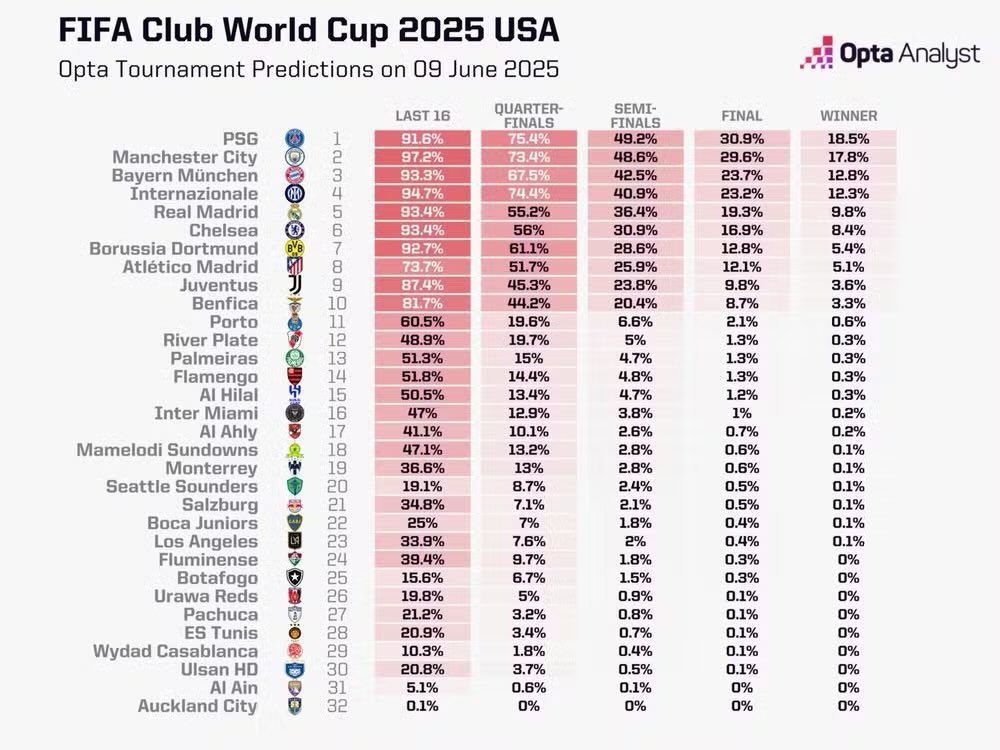
– Ninguém fala mais sobre o Supercomputador Opta e as previsões do Mundial de Clubes?

Antes da Copa do Mundo de Clubes começar, noticiou-se as projeções dos finalistas com base na Inteligência Artificial. E muito se falou das chances dos times de acordo com o Supercomputador Opta!

Por ele, o Fluminense teria míseros 1,8% de chances em chegar à Semifinal. Já o Manchester City (eliminado nas quartas)…

Veja como o futebol é fantástico, no percentual de cada time passar de fase, e compare com a realidade. Abaixo:

– O Palmeiras foi eliminado, sem vencer nenhum europeu. Fim de alguns ciclos?

O Palmeiral foi eliminado pelo Chelsea no Mundial de Clubes. Provavelmente, estará na segunda edição da competição, pelo ranking Conmebol ou algum título, é fato (igualmente ao Flamengo, River Plate ou Boca Jrs).

O Verdão foi o 5º clube no mundo que mais gastou em reforços (um número curioso). E vejamos: pouco produziu nessa Copa do Mundo de Clubes, em todos os seus jogos, apesar de ir passando de fase.

Curiosamente, foi o único time brasileiro que não venceu nenhum europeu no torneio (o Botafogo venceu o PSG, o Flamengo o Chelsea e o Fluminense a Internazionale de Milão).

As piadinhas, obviamente, continuarão sobre “ter ou não Mundial”. Mas a questão é: alguns ciclos estão terminando, como o do goleiro Weverton ou do treinador Abel?

Não estamos questionando a qualidade deles, mas: a motivação, o desempenho nesse ambiente e o tempo de casa. Afinal, muitas vezes, arejar é necessário.

IN ENGLISH – Palmeiras was eliminated by Chelsea in the Club World Cup. It will probably be in the second edition of the competition, based on the Conmebol ranking or some title, that’s a fact (just like Flamengo, River and/or Boca Jrs).

Verdão was the 5th club in the world that spent the most on reinforcements (a curious number). And let’s see: it produced little in this Club World Cup, in all its games, despite advancing to the next phase.

Interestingly, it was the only Brazilian team that did not beat any European team in the tournament (Botafogo beat PSG, Flamengo beat Chelsea and Fluminense beat Internazionale Milano).

The jokes, obviously, will continue about “to have or not to have a World Cup”. But the question is: are some cycles ending, like that of goalkeeper Weverton or coach Abel?

We are not questioning their quality, but: their motivation, their performance in this environment and their time in the club. After all, many times, a breather is necessary.

– O Fluminense de ontem e o de hoje.

Há aproximadamente 8 meses, o Fluminense estava festejando o fato de ter escapado da Série B do Brasileirão e Renato Gaúcho estava dando entrada no “Seguro Desemprego”, após mais uma passagem pelo Grêmio…

Hoje, o Tricolor Carioca está na semifinal do Mundial de Clubes!

O futebol não é sensacional?

Vídeo completo em: https://youtu.be/R1qJfadbnXo?si=IJOVmOdZixyfEuoi

In ENGLISH – About 8 months ago, Fluminense was celebrating the fact that it had escaped from the Série B of the Brazilian Championship and Renato Gaúcho was applying for “Unemployment Insurance”, after yet another stint at Grêmio…

Today, Tricolor Carioca is in the semifinals of the Club World Cup!

Isn’t football amazing?

Full video at: https://youtu.be/R1qJfadbnXo?si=IJOVmOdZixyfEuoi

– Marcos Leonardo tentou cavar um pênalti bisonhamente.

Tinha que ser brasileiro! Que cavada que o Marcos Leonardo deu…

Ainda bem que há o VAR!

Faltou o Cartão Amarelo por simulação.

#Fluminense 1×0 #AlHilal (parcial).

– A influência (positiva ou negativa) dos treinadores no Mundial de Clubes.

Em Copa do Mundo de Seleções, o que há de mais novo, inédito e polêmico espelha e repercute aos aficcionados por futebol. No Mundial de Clubes, esse mesmo fenômeno se repete:

Se os árbitros exagerarem nos acréscimos, na primeira oportunidade que os campeonatos locais voltarem, os juízes daquele torneio farão a mesma coisa.

Se um treinador abdica do futebol-arte e cria o conceito de pragmático, outros imitam (em 1994, vimos o efeito Parreira contagiar o Brasil devido a conquista do Tetracampeonato da Seleção Brasileira). E por aí vai.

E é justamente sobre os treinadores que precisamos falar: vimos estilos contraditórios e polêmicos nessa edição da Copa do Mundo de Clubes. Exemplos:

  1. Renato Paiva venceu o Paris-Saint Germain por 1×0, abdicando do jogo e tentando ganhar “por uma bola”. Foi exaltado e virou referência para alguns. Mas ao perder por 1×0 do Palmeiras… de herói a vilão com uma facilidade enorme. E depois disso, perdeu o emprego.
  2. Renato Gaúcho, desacreditado e ironizado, que sarcasticamente falava sobre “treinar na praia”, “jogar futevôlei ao invés de estudar”, e outras tantas tiradas cômicas, avançou bastante na competição.
  3. Pep Guardiola, estudioso e referência para os demais, ao contrário, foi eliminado precocemente pelo Al Hilal.
  4. Abel Ferreira, por fim, de tantos títulos no Brasil, especialmente na primeira fase, foi criticado por falta de variação tática. Mas chegou à frente de muitos concorrentes.

Quatro treinadores de quatro estilos diferentes e de comportamentos bem próprios. O vencedor do Mundial, certamente, vai influenciar muita gente. Simone Inzaghi, treinador da nova geração, declarou sobre a influência de Pep:

Acredito que todo treinador que começa a treinar considera Guardiola uma inspiração. Houve futebol antes e haverá depois de Guardiola, mas ele desenvolveu uma nova filosofia e uma nova maneira de jogar. É o melhor treinador dos últimos 20-25 anos e é um grande exemplo para nós como técnicos.

Em nosso país, as influências positivas e negativas dos treinadores em grandes competições ganham um elemento próprio: a questão dos modismos! Já repararam que temos fases?

A fase dos veteranos (onde vimos a volta de Felipão), a fase dos assistentes técnicos efetivados (vide Fábio Carille), a fase dos jovens treinadores (Thiago Carpini), e a mais duradoura: a dos treinadores estrangeiros (em destaque, a onda portuguesa). E essa é a mais complicada, pois vemos treinadores brasileiros (que precisam de atualização) perdendo espaço.

Prova disso são os nomes dos técnicos nas Eliminatórias da Copa do Mundo. Dos 10 envolvidos, 8 são argentinos e nenhum é brasileiro. Vide:

Argentina – Lionel Scaloni (Argentina)

Bolívia – Óscar Villegas (Bolívia)

Brasil – Carlo Ancelotti (Itália)

Chile – Ricardo Gareca (Argentina)

Colômbia – Néstor Lorenzo (Argentina)

Equador – Sebastian Beccacece (Argentina)

Paraguai – Gustavo Alfaro (Argentina)

Peru – Óscar Ibañez (Argentina)

Uruguai – Marcelo Bielsa (Argentina)

Venezuela – Fernando Batista (Argentina)

A questão é: o Brasil mudará seu cenário aos técnicos locais? O intercâmbio haverá? E principalmente: que lições o Mundial de Clubes estará trazendo aos treinadores iniciantes?
IN ENGLISH – In the World Cup, the newest, most unprecedented and controversial things are reflected and resonate with football fans. In the Club World Cup, this same phenomenon is repeated:

If the referees exaggerate in the injury time, the referees of that tournament will do the same thing the first time the local championships return.

If a coach abandons the artistic side of football and creates the concept of pragmatism, others will follow suit (in 1994, we saw the Parreira effect spread to Brazil due to the Brazilian national team winning its fourth championship). And so on.

And it is precisely about the coaches that we need to talk: we saw contradictory and controversial styles in this edition of the Club World Cup. Examples:

Renato Paiva beat Paris-Saint Germain 1-0, giving up the game and trying to win “by a ball”. He was praised and became a reference for some. But when he lost 1-0 to Palmeiras… he went from hero to villain with great ease. And after that, he lost his job.

Renato Gaúcho, who was discredited and mocked, who sarcastically talked about “training on the beach”, “playing footvolley instead of studying”, and many other comical remarks, advanced significantly in the competition.

Pep Guardiola, a scholar and a reference for others, on the other hand, was eliminated early by Al Hilal.

Abel Ferreira, finally, who won so many titles in Brazil, especially in the first phase, was criticized for his lack of tactical variation. But he came out ahead of many competitors.

Four coaches with four different styles and very unique behaviors. The winner of the World Cup will certainly influence many people. Simone Inzaghi, coach of the new generation, said about Pep’s influence:

“I believe that every coach who starts coaching considers Guardiola an inspiration. There was football before and there will be after Guardiola, but he developed a new philosophy and a new way of playing. He is the best coach of the last 20-25 years and is a great example for us as coaches.”

In our country, the positive and negative influences of coaches in major competitions gain their own element: the issue of fads! Have you noticed that we have phases?

The phase of veterans (where we saw the return of Felipão), the phase of permanent assistant coaches (see Fábio Carille), the phase of young coaches (Thiago Carpini), and the longest-lasting: that of foreign coaches (in particular, the Portuguese wave). And this is the most complicated, because we see Brazilian coaches (who need to update themselves) losing ground.

Proof of this are the names of the coaches in the World Cup Qualifiers. Of the 10 involved, 8 are Argentine and none are Brazilian. See:

Argentina – Lionel Scaloni (Argentina)

Bolivia – Óscar Villegas (Bolivia)

Brazil – Carlo Ancelotti (Italy)

Chile – Ricardo Gareca (Argentina)

Colombia – Néstor Lorenzo (Argentina)

Ecuador – Sebastian Beccacece (Argentina)

Paraguay – Gustavo Alfaro (Argentina)

Peru – Óscar Ibañez (Argentina)

Uruguay – Marcelo Bielsa (Argentina)

Venezuela – Fernando Batista (Argentina)

The question is: will Brazil change its scenario for local coaches? Will there be an exchange? And most importantly: what lessons will the Club World Cup be bringing to new coaches?

– Ninguém fala mais sobre o Supercomputador Opta e as previsões do Mundial de Clubes?

Antes da Copa do Mundo de Clubes começar, noticiou-se as projeções dos finalistas com base na Inteligência Artificial. E muito se falou das chances dos times de acordo com o Supercomputador Opta!

Por ele, o Fluminense teria míseros 1,8% de chances em chegar à Semifinal. Já o Manchester City (eliminado nas quartas)…

Veja como o futebol é fantástico, no percentual de cada time passar de fase, e compare com a realidade. Abaixo:

– O Impedimento por IA é a grande contribuição do Mundial até agora!

Não tivemos polêmicas de arbitragem na Copa do Mundo de Clubes até agora. Aliás uma novidade, que é o uso da tecnologia aos árbitros assistentes.

A grande contribuição do Mundial de Clubes, até então: o impedimento por Inteligência Artificial, com alerta aos bandeiras. Nada de “na dúvida, deixe o jogo seguir” (como acontece aqui, onde os narradores narram e esperam o VAR confirmar o gol, ou não narram e aguardam pra gritar gol).

O uso do árbitro de vídeo em impedimentos é angustiante para jogadores e torcedores. E a pergunta é: quando veremos esse bom sistema, automático, de tecnologia nos campos brasileiros? Se nem o semi-automático (da Copa de 2022) ainda temos, quiçá esse tão moderno?

Nos resta aguardar.

IN ENGLISH – We have not had any refereeing controversies at the Club World Cup so far. In fact, one new feature is the use of technology for assistant referees.

The Club World Cup’s biggest contribution so far: offside by Artificial Intelligence, with alerts to the linesmen. No more “when in doubt, let the game continue” (as happens here, where the commentators narrate and wait for the VAR to confirm the goal, or don’t narrate and wait to call a goal).

The use of the video referee in offside calls is distressing for players and fans. And the question is: when will we see this good, automatic, technological system on Brazilian pitches? If we don’t even have the semi-automatic one (from the 2022 World Cup) yet, perhaps this modern one?

We can only wait.

– A influência (positiva ou negativa) dos treinadores no Mundial de Clubes.

Em Copa do Mundo de Seleções, o que há de mais novo, inédito e polêmico espelha e repercute aos aficcionados por futebol. No Mundial de Clubes, esse mesmo fenômeno se repete:

Se os árbitros exagerarem nos acréscimos, na primeira oportunidade que os campeonatos locais voltarem, os juízes daquele torneio farão a mesma coisa.

Se um treinador abdica do futebol-arte e cria o conceito de pragmático, outros imitam (em 1994, vimos o efeito Parreira contagiar o Brasil devido a conquista do Tetracampeonato da Seleção Brasileira). E por aí vai.

E é justamente sobre os treinadores que precisamos falar: vimos estilos contraditórios e polêmicos nessa edição da Copa do Mundo de Clubes. Exemplos:

  1. Renato Paiva venceu o Paris-Saint Germain por 1×0, abdicando do jogo e tentando ganhar “por uma bola”. Foi exaltado e virou referência para alguns. Mas ao perder por 1×0 do Palmeiras… de herói a vilão com uma facilidade enorme. E depois disso, perdeu o emprego.
  2. Renato Gaúcho, desacreditado e ironizado, que sarcasticamente falava sobre “treinar na praia”, “jogar futevôlei ao invés de estudar”, e outras tantas tiradas cômicas, avançou bastante na competição.
  3. Pep Guardiola, estudioso e referência para os demais, ao contrário, foi eliminado precocemente pelo Al Hilal.
  4. Abel Ferreira, por fim, de tantos títulos no Brasil, especialmente na primeira fase, foi criticado por falta de variação tática. Mas chegou à frente de muitos concorrentes.

Quatro treinadores de quatro estilos diferentes e de comportamentos bem próprios. O vencedor do Mundial, certamente, vai influenciar muita gente. Simone Inzaghi, treinador da nova geração, declarou sobre a influência de Pep:

Acredito que todo treinador que começa a treinar considera Guardiola uma inspiração. Houve futebol antes e haverá depois de Guardiola, mas ele desenvolveu uma nova filosofia e uma nova maneira de jogar. É o melhor treinador dos últimos 20-25 anos e é um grande exemplo para nós como técnicos.

Em nosso país, as influências positivas e negativas dos treinadores em grandes competições ganham um elemento próprio: a questão dos modismos! Já repararam que temos fases?

A fase dos veteranos (onde vimos a volta de Felipão), a fase dos assistentes técnicos efetivados (vide Fábio Carille), a fase dos jovens treinadores (Thiago Carpini), e a mais duradoura: a dos treinadores estrangeiros (em destaque, a onda portuguesa). E essa é a mais complicada, pois vemos treinadores brasileiros (que precisam de atualização) perdendo espaço.

Prova disso são os nomes dos técnicos nas Eliminatórias da Copa do Mundo. Dos 10 envolvidos, 8 são argentinos e nenhum é brasileiro. Vide:

Argentina – Lionel Scaloni (Argentina)

Bolívia – Óscar Villegas (Bolívia)

Brasil – Carlo Ancelotti (Itália)

Chile – Ricardo Gareca (Argentina)

Colômbia – Néstor Lorenzo (Argentina)

Equador – Sebastian Beccacece (Argentina)

Paraguai – Gustavo Alfaro (Argentina)

Peru – Óscar Ibañez (Argentina)

Uruguai – Marcelo Bielsa (Argentina)

Venezuela – Fernando Batista (Argentina)

A questão é: o Brasil mudará seu cenário aos técnicos locais? O intercâmbio haverá? E principalmente: que lições o Mundial de Clubes estará trazendo aos treinadores iniciantes?

IN ENGLISH – In the World Cup, the newest, most unprecedented and controversial things are reflected and resonate with football fans. In the Club World Cup, this same phenomenon is repeated:

If the referees exaggerate in the injury time, the referees of that tournament will do the same thing the first time the local championships return.

If a coach abandons the artistic side of football and creates the concept of pragmatism, others will follow suit (in 1994, we saw the Parreira effect spread to Brazil due to the Brazilian national team winning its fourth championship). And so on.

And it is precisely about the coaches that we need to talk: we saw contradictory and controversial styles in this edition of the Club World Cup. Examples:

Renato Paiva beat Paris-Saint Germain 1-0, giving up the game and trying to win “by a ball”. He was praised and became a reference for some. But when he lost 1-0 to Palmeiras… he went from hero to villain with great ease. And after that, he lost his job.

Renato Gaúcho, who was discredited and mocked, who sarcastically talked about “training on the beach”, “playing footvolley instead of studying”, and many other comical remarks, advanced significantly in the competition.

Pep Guardiola, a scholar and a reference for others, on the other hand, was eliminated early by Al Hilal.

Abel Ferreira, finally, who won so many titles in Brazil, especially in the first phase, was criticized for his lack of tactical variation. But he came out ahead of many competitors.

Four coaches with four different styles and very unique behaviors. The winner of the World Cup will certainly influence many people. Simone Inzaghi, coach of the new generation, said about Pep’s influence:

“I believe that every coach who starts coaching considers Guardiola an inspiration. There was football before and there will be after Guardiola, but he developed a new philosophy and a new way of playing. He is the best coach of the last 20-25 years and is a great example for us as coaches.”

In our country, the positive and negative influences of coaches in major competitions gain their own element: the issue of fads! Have you noticed that we have phases?

The phase of veterans (where we saw the return of Felipão), the phase of permanent assistant coaches (see Fábio Carille), the phase of young coaches (Thiago Carpini), and the longest-lasting: that of foreign coaches (in particular, the Portuguese wave). And this is the most complicated, because we see Brazilian coaches (who need to update themselves) losing ground.

Proof of this are the names of the coaches in the World Cup Qualifiers. Of the 10 involved, 8 are Argentine and none are Brazilian. See:

Argentina – Lionel Scaloni (Argentina)

Bolivia – Óscar Villegas (Bolivia)

Brazil – Carlo Ancelotti (Italy)

Chile – Ricardo Gareca (Argentina)

Colombia – Néstor Lorenzo (Argentina)

Ecuador – Sebastian Beccacece (Argentina)

Paraguay – Gustavo Alfaro (Argentina)

Peru – Óscar Ibañez (Argentina)

Uruguay – Marcelo Bielsa (Argentina)

Venezuela – Fernando Batista (Argentina)

The question is: will Brazil change its scenario for local coaches? Will there be an exchange? And most importantly: what lessons will the Club World Cup be bringing to new coaches?

– E quando o Brasileirão recomeçar?

Todos nós estamos acompanhando o emocionante Mundial de Clubes! Essa Copa do Mundo de Clubes “pegou”, está legal e empolgando. Uma “bola dentro” da FIFA.

Pelo momento econômico do futebol brasileiro, representando a Conmebol, 4 brasileiros estão na disputa. Só que…

E quando voltarem ao Campeonato Brasileiro? Enquanto seus adversários descansaram e fizeram uma intertemporada, Botafogo e Flamengo estarão cansados – mas especialmente Fluminense e Palmeiras, que avançaram de fase.

Jogando no calor, em horários inapropriados (embora muito bem remunerados), os clubes que avançam de fase sacrificarão suas equipes no Brasileirão. E tal período, nesse tempo de tanta exigência física no futebol, fará a diferença.

É o ônus do sucesso, sem dúvida. Mas aí eu me recordo do Raphinha, do Barcelona, que disse ser uma loucura sacrificar as férias pelo Mundial. Talvez ele tenha exagerado, mas que a FIFA deverá rever o calendário mundial, não se discute.

Imagine a “alegria” dos europeus, após o término da temporada, nessas condições?

Eu estou curtindo a competição, mas sei que sua incorporação ao calendário regular é uma insanidade, fisicamente falando.

IN ENGLISH – We are all following the exciting Club World Cup! This Club World Cup is “on the up”, it’s cool and exciting. A “goal” by FIFA,

Given the economic situation of Brazilian football, representing Conmebol, 4 Brazilians are in the competition. But…

And when they return to the Brazilian Championship? While their opponents rested and had an off-season, Botafogo and Flamengo will be tired – but especially Fluminense and Palmeiras, who advanced to the next phase.

Playing in the heat, at inappropriate times (although very well paid), the clubs that advance to the next phase will sacrifice their teams in the Brasileirão. And such a period, in this time of so much physical demand in football, will make a difference.

It is the burden of success, without a doubt. But then I remember Raphinha, from Barcelona, ​​who said it was crazy to sacrifice vacation for the World Cup. Maybe he exaggerated, but there is no debate about the fact that FIFA will have to review the world calendar.

Imagine the “joy” of the Europeans after the end of the season, under these conditions?

I am enjoying the competition, but I know that incorporating it into the regular calendar is insane, physically speaking.

– Minha coluna no Jornal de Jundiaí de hoje.

Prestigie minha coluna no JJ de hoje. Falamos sobre “quem tem Mundial de Clubes”!

Para a FIFA, ninguém. Somente campeões intercontinentais! E o primeiro será conhecido em 2025

Na íntegra, em: https://sampi.net.br/jundiai/noticias/2913037/opinioes/2025/07/a-fifa-decreta-nenhum-time-tem-mundial-

– Quem passará de fase no Mundial de Clubes?

E aí: teremos quantos sulamericanos na semifinal do Mundial de Clubes?

Do outro lado, obviamente teremos dois europeus

Tá legal essa Copa do Mundo de Clubes, não?

– O Impedimento por IA é a grande contribuição do Mundial até agora!

Não tivemos polêmicas de arbitragem na Copa do Mundo de Clubes até agora. Aliás uma novidade, que é o uso da tecnologia aos árbitros assistentes.

A grande contribuição do Mundial de Clubes, até então: o impedimento por Inteligência Artificial, com alerta aos bandeiras. Nada de “na dúvida, deixe o jogo seguir” (como acontece aqui, onde os narradores narram e esperam o VAR confirmar o gol, ou não narram e aguardam pra gritar gol).

O uso do árbitro de vídeo em impedimentos é angustiante para jogadores e torcedores. E a pergunta é: quando veremos esse bom sistema, automático, de tecnologia nos campos brasileiros? Se nem o semi-automático (da Copa de 2022) ainda temos, quiçá esse tão moderno?

Nos resta aguardar.

IN ENGLISH – We have not had any refereeing controversies at the Club World Cup so far. In fact, one new feature is the use of technology for assistant referees.

The Club World Cup’s biggest contribution so far: offside by Artificial Intelligence, with alerts to the linesmen. No more “when in doubt, let the game continue” (as happens here, where the commentators narrate and wait for the VAR to confirm the goal, or don’t narrate and wait to call a goal).

The use of the video referee in offside calls is distressing for players and fans. And the question is: when will we see this good, automatic, technological system on Brazilian pitches? If we don’t even have the semi-automatic one (from the 2022 World Cup) yet, perhaps this modern one?

We can only wait.

– Xabi Alonso sobre o Mundial de Clubes:

Quem é louco de não gostar do Mundial de Clubes?

Estou acompanhando Juventus vs Real Madrid (o segundo tempo está muito bom). E leio o que Xabi Alonso disse ontem:

“O Mundial de Clubes me parece ótimo. O jogo do PSG contra o Bayern está chegando, acabamos de assistir o Fluminense vencer a Inter. Se você é fã de futebol, você é fã deste torneio!”.

Assino embaixo. Como discordar?

Resta saber: na próxima sexta-feira, Palmeiras e Fluminense, os brasileiros, avançarão?

Seria muito legal um confronto Europa – América do Sul na final.

Who is crazy enough not to like the Club World Cup?

I’m watching Juventus vs Real Madrid (the second half is very good). And I read what Xabi Alonso said yesterday:

“The Club World Cup looks great to me. The PSG vs Bayern game is coming up, we just watched Fluminense beat Inter. If you’re a football fan, you’re a fan of this tournament!”

I agree. How could I disagree?

The question remains: will Palmeiras and Fluminense, the Brazilians, advance next Friday?

It would be really cool to see a Europe vs South America match in the final.

– A vontade do FLA foi cumprida pelo FLU, taticamente? Veja que curioso:

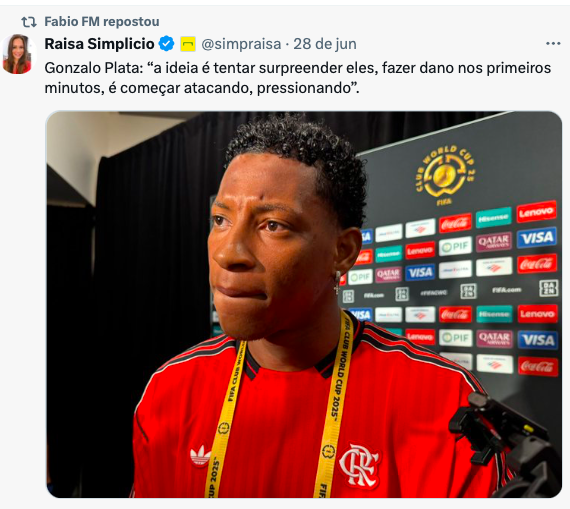
E Gonzalo Plata (na imagem abaixo) disse à jornalista Raisa Simplicio como o Flamengo deveria jogar diante do Bayern. E não deu certo.

E não é que Renato Gaúcho fez exatamente o que o Mengão faria, com o Fluminense diante da Internazionale?

O mais curioso de tudo é que podemos ter, dentro em breve, repetições de dois confrontos de Intercontinentais: Fluminense x Manchester City e Palmeiras x Chelsea. (ATUALIZAÇÃO: e deu Al Hilal!!!!!).

Dos times brasileiros, sem dúvida o Fluzão é a surpresa. Brigou contra o rebaixamento (surgiu a preocupação de estar no Mundial, disputando a série B nesse ano). Demitiu Mano Menezes e trouxe Renato, questionado pelos discursos polêmicos, estratégias motivacionais e pouca tática. E está dando certo!

Será que os veteranos Thiago Silva e Fábio conseguirão aguentar esse frenético ritmo de calor? O zagueiro, não sei. O goleiro, menos mal. Mas a FIFA poderia repensar os horários.

Aguardemos.

ENGLISH

And Gonzalo Plata (pictured above) told journalist Raisa Simplicio how Flamengo should play against Bayern. And it didn’t work.

And isn’t it true that Renato Gaúcho did exactly what Mengão would do, with Fluminense against Internazionale?

The most curious thing of all is that we may soon have repeats of two Intercontinental Cup matches: Fluminense vs. Manchester City and Palmeiras vs. Chelsea.

Of the Brazilian teams, Fluzão is undoubtedly the surprise. They fought against relegation (they were worried about being in the World Cup, playing in the B series this year). They fired Mano Menezes and brought in Renato, who was questioned for his controversial speeches, motivational strategies and lack of tactics. And it’s working!

Will veterans Thiago Silva and Fábio be able to handle this frenetic pace of heat? The defender, I don’t know. The goalkeeper, not so bad. But FIFA could rethink the schedules.

Let’s wait.

– Manchester City 3×4 Al-Hilal: a grande zebra do Mundial?

O Al-Hilal venceu o Manchester City por 4×3 pela Copa do Mundo de Clubes 2025 e está surpreendentemente nas Quartas-de-final do torneio. E me “derrubou nas minhas apostas”, pois achava que os ingleses seriam favoritíssimos.

No confronto “Emirados Árabes Unidos versus Arábia Saudita”, Marcos Leonardo foi o destaque contra o time de Pep Guardiola. Imagino que Carlo Ancelotti (treinador da Seleção Brasileira) esteja observando o atacante (ex-Santos FC, que um dia foi sondado pelo Flamengo). Aliás, do outro lado, Savinho não foi bem (e falamos no dia anterior que Guardiola havia “enchido a bola dele”).

Falamos sobre o jogo brevemente em 1 minuto, aqui, em: https://youtu.be/BgDdReFLgmM?si=0AxqGpf19n4m0zVa

ENGLISH – Al-Hilal beat Manchester City 4-3 in the 2025 Club World Cup and are surprisingly in the quarterfinals of the tournament.

In the “UAE vs. Saudi Arabia” match, Marcos Leonardo was the standout performer against Pep Guardiola’s time. Imagine if Carlo Ancelotti was watching the striker. By the way, on the other side, Savinho didn’t do well.

We talked about the game briefly in 1 minute, here, at: https://youtu.be/BgDdReFLgmM?si=0AxqGpf19n4m0zVa

Visite meu blog: Discutindo Contemporaneidades, de assuntos diversos. 

Visite também meu blog de arbitragem: Pergunte Ao Árbitro. 

Acesse também minha coluna no Jornal de Jundiaí

Obrigado pelo prestígio. 

– Quem passará de fase no Mundial de Clubes?

E aí: teremos quantos sulamericanos na semifinal do Mundial de Clubes?

Do outro lado, obviamente teremos dois europeus

Tá legal essa Copa do Mundo de Clubes, não?

– E quando o Brasileirão recomeçar?

Todos nós estamos acompanhando o emocionante Mundial de Clubes! Essa Copa do Mundo de Clubes “pegou”, está legal e empolgando. Uma “bola dentro” da FIFA.

Pelo momento econômico do futebol brasileiro, representando a Conmebol, 4 brasileiros estão na disputa. Só que…

E quando voltarem ao Campeonato Brasileiro? Enquanto seus adversários descansaram e fizeram uma intertemporada, Botafogo e Flamengo estarão cansados – mas especialmente Fluminense e Palmeiras, que avançaram de fase.

Jogando no calor, em horários inapropriados (embora muito bem remunerados), os clubes que avançam de fase sacrificarão suas equipes no Brasileirão. E tal período, nesse tempo de tanta exigência física no futebol, fará a diferença.

É o ônus do sucesso, sem dúvida. Mas aí eu me recordo do Raphinha, do Barcelona, que disse ser uma loucura sacrificar as férias pelo Mundial. Talvez ele tenha exagerado, mas que a FIFA deverá rever o calendário mundial, não se discute.

Imagine a “alegria” dos europeus, após o término da temporada, nessas condições?

Eu estou curtindo a competição, mas sei que sua incorporação ao calendário regular é uma insanidade, fisicamente falando.

IN ENGLISH – We are all following the exciting Club World Cup! This Club World Cup is “on the up”, it’s cool and exciting. A “goal” by FIFA,

Given the economic situation of Brazilian football, representing Conmebol, 4 Brazilians are in the competition. But…

And when they return to the Brazilian Championship? While their opponents rested and had an off-season, Botafogo and Flamengo will be tired – but especially Fluminense and Palmeiras, who advanced to the next phase.

Playing in the heat, at inappropriate times (although very well paid), the clubs that advance to the next phase will sacrifice their teams in the Brasileirão. And such a period, in this time of so much physical demand in football, will make a difference.

It is the burden of success, without a doubt. But then I remember Raphinha, from Barcelona, ​​who said it was crazy to sacrifice vacation for the World Cup. Maybe he exaggerated, but there is no debate about the fact that FIFA will have to review the world calendar.

Imagine the “joy” of the Europeans after the end of the season, under these conditions?

I am enjoying the competition, but I know that incorporating it into the regular calendar is insane, physically speaking.

– Cooling Break: onde está na Regra?

Para quem acompanha a Copa do Mundo de Clubes, reparou que em Internaziomale x Fluminense (assim cimo em outros jogos), a partida foi paralisada devido ao forte calor.

Não é comum vermos, fora do Brasil, tal situação. Mas saiba: existem dois tipos de parada pelo excesso de calor nas Regras do Jogo (texto extraído das Regras oficiais):

1- Paradas para arrefecimento:
No interesse do bem-estar e segurança dos jogadores, os Regulamento das Competições podem permitir, sob certas condições climatéricas (alta umidade e temperatura), paradas para resfriamento (normalmente entre noventa segundos e três minutos) a fim de permitir baixar a temperatura corporal; isto é diferente das paradas para hidratação.

2- Paradas para hidratação:
Os Regulamento das Competições podem permitir paradas para hidratação (não mais de um minuto) para permitir aos jogadores se hidratarem; isto é diferente das paradas para arrefecimento.

Ao ler o texto, já deu para perceber: temos um vício em dizer que no Brasil fazemos Parada para Hidratação. São, na verdade, Paradas de Resfriamento. Um detalhe da regra…

ENGLISH

For those who follow the Club World Cup, you will have noticed that in Internazionale x Fluminense (as well as in other games), the match was stopped due to the intense heat.

It is not common to see such a situation outside of Brazil. But be aware that there are two types of stoppages due to excessive heat in the Rules of the Game (text extracted from the official Rules):

1- Cooling down breaks:

In the interest of the well-being and safety of the players, the Competition Regulations may allow, under certain weather conditions (high humidity and temperature), cooling down breaks (normally between ninety seconds and three minutes) in order to allow the body temperature to drop; this is different from hydration breaks.

2- Hydration breaks:
The Competition Regulations may allow hydration breaks (no more than one minute) to allow the players to hydrate themselves; this is different from cooling down breaks.

As you read the text, you will have already realized: we have a habit of saying that in Brazil we do Hydration Breaks. They are, in fact, Cooling Stops. A detail of the rule…

– Os europeus favoritos ditam a Copa do Mundo de Clubes.

Nós já havíamos falado que os favoritos ao título de Campeão do Mundo de Clubes eram os europeus “grandões”. E que não poderíamos nos iludir com a boa apresentação dos brasileiros na primeira fase.

Vide tudo isso que foi dito aqui: https://wp.me/p4RTuC-18cm

Pois bem: o Bayern venceu por 4×2 o Flamengo, mas esse não foi o detalhe. O ponto alto foi: o início do jogo!

Os alemães se impuseram e o Mengão sentiu, errando muito. Não teve segredo. Paciência.

Continuo com a opinião: o título não sairá de Manchester City ou PSG.

– E o Botafogo fez “sobrar” para Renato Paiva?

O futebol brasileiro é sempre imprevisível.

Há uma semana, Renato Paiva, treinador do Botafogo, era um gênio por vencer o PSG. Agora, após retrancar o time e perder do Palmeiras, virou “burro” (terno que o próprio Renato disse nunca ter sido chamado e que seu debute foi no Bahia).

Cá entre nós: será que a decisão do Botafogo em demitir Paiva se deu ao Mundial de Clubes, ou existe um bastidor que não conhecemos?